
 How to measure your bust and properly understand bra sizes?
Wondering what bra size to choose? Learn how to properly measure your bust and understand the meaning behind bra sizes. Ensure your comfort with the right underwear.
From the article you will learn:
- How to accurately measure the circumference under the bust and around the bust.
- What to pay attention to when choosing a bra cup size.
- Why the correct bra size is crucial for comfort.
- How to interpret differences in bra sizes from different manufacturers.
- How to avoid the most common mistakes when measuring your bust.
- What to do when dimensions differ from accepted standards.
- How to find the perfect bra without leaving home.
Are you putting off buying a new bra because you don't fully understand the differences between bra sizes? Unsure how to take accurate measurements? We've prepared a comprehensive guide that will teach you how to navigate the sizing charts. Brew your favorite coffee and spend a few minutes reading this book, which will change the way you think about buying lingerie.
How to take measurements to choose the right bra?
Bra sizes are defined by numbers and letters, for example, 75B. The number represents the bra circumference, while the letter represents the cup size. To choose a bra size, you need to do two things: measure the circumference under the bust and the circumference around the bust . A tape measure can help.
Step 1 - Measure the circumference under the bust

The circumference under the bust is measured so that the tape measure fits snugly against the body directly under the bust. Make sure the tape measure lies evenly and at the same height both at the front and back of the body. Measure while naked, preferably while exhaling. The bust circumference is a multiple of "5," so the result is rounded down. For example, 87 cm is 85 cm, 93 cm is 90 cm, 89 cm is 85 cm, 63 cm is 60 cm, and so on.
Step 2 - measure your bust circumference

The bust circumference is measured at the fullest part of the breast, i.e., across the center of the nipples. The measurement should be taken while standing upright, wearing a bare chest or a soft bra. For women with sagging breasts, it is recommended to measure the bust circumference while wearing a soft bra and leaning forward slightly. Do not exhale while measuring, and do not squeeze the measuring tape too tightly, as when measuring under the bust.
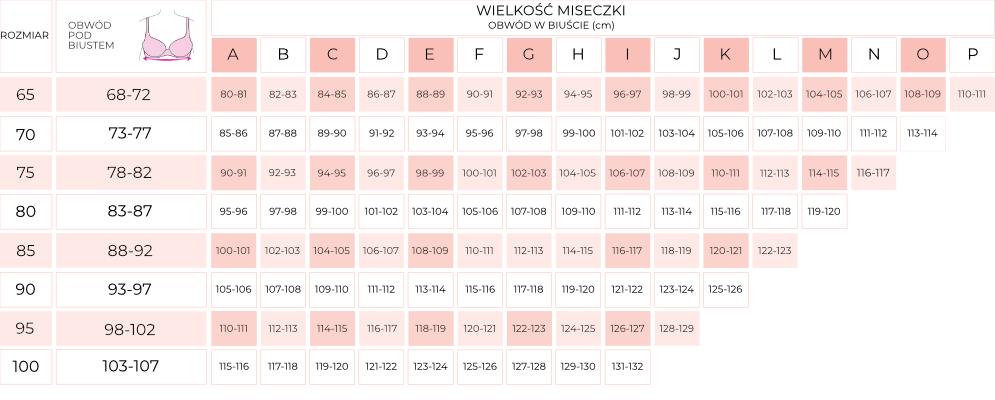
The table below will help us determine what cup size we wear .
First, find your band size, then check your cup size. For example, if you have an underbust measurement of 85 cm and a bust measurement of 100 cm, you'll get a size 80C.
Step 3 - Check the bra cups

Check that your breasts don't protrude above or below the bra cups. If so, the cups are too small. Check that the fabric on the cups isn't bunching or sagging. If it bunches, the cups are too large.
Step 4 - Check the circumference and straps

Check that the band of the bra lies horizontally across the bust line. If it rides up at the back, the band is too loose. If the bra is tight and leaves marks, the band is too tight.
Remember that a new bra should be fastened on the loosest hook. Why? The fibers in the fabric stretch with use, causing the band to loosen. By fastening the bra on a tighter hook, you can easily correct any looseness. Check the bra straps. They should be slightly taut, just enough to stay on your shoulders and not leave marks on your skin.
Sister bra sizes
So you've found your dream bra, tried it on, and... the cups fit perfectly, but the band is too loose or, conversely, too small? Try sister bra sizes! What's the big deal? Sister bra sizes are sizes that have the same cup size but different underbust measurements. If you look at the bra size chart below, you'll find sister sizes close together, aligned on the same line. So much for the theory, what does it look like in practice?
Example 1.
You tried on a size 80D, but the band is too tight? The rule of thumb for sister sizes is "when you increase your underbust band, decrease your cup size by one." Accordingly, try on a size 85C bra. This way, you'll get an increased band size while maintaining the same cup size.
Example 2.
The aforementioned 80D band size is too loose? Try a 75E bra. Why? According to the rule of sister bras, "when you decrease the band size under the bust, increase the cup size by one." You'll get a smaller band size with the same cup size.
Sister bra sizes - table
75E←80D→85C (sister sizes)
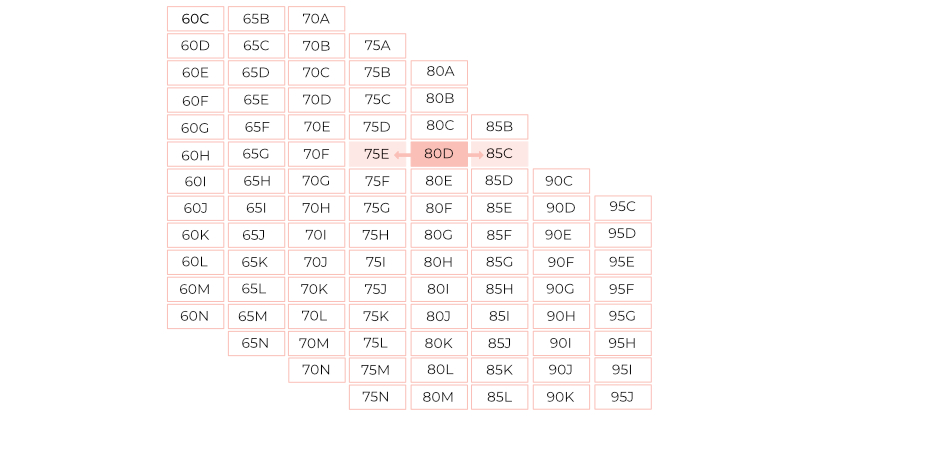
The sister bra size chart is a tool used by both customers who want to determine their bra size themselves and professional bra fitters.
How to choose the right bra?
A well-fitting bra is one you can… forget about. You don't constantly adjust the straps that sag. You don't search for a hidden spot to fasten the hook. You don't stuff the "rolls" from your bottom or armpits inside. You don't hiss in pain when you discover red welts on your skin, and you don't ask yourself in the mirror: is this still a bra or already an instrument of torture?
A bra should provide invisible support in all your daily activities—no matter what you do. But for that to happen, you need to take the time to learn how to choose your bra size. It's knowledge that will come in handy many times. No need to take notes—you can save this article for future reference and refer back to it whenever you need it.
What should you consider when choosing a bra size?
Choosing the right bra size is essential for everyday comfort and an important part of health care. To find the perfect fit, it's crucial to focus primarily on accurate measurements and understanding how the sizing system works. A well-fitting bra not only enhances the appearance of your figure but also provides proper support for your bust and promotes proper posture.
Bra size is composed of two elements: the under bust measurement and the cup size. The band size provides stability and support – it should fit snugly, but not cause pressure or discomfort. The cups, on the other hand, should fully enclose the bust, not protrude or press against the breasts, providing even support. Only properly fitted cups guarantee all-day comfort.
If you're wondering how to choose the right bra, start with accurate measurements. Measure the circumference under the bust tightly, running the tape measure horizontally around the body, and the circumference around the bust at its fullest point, at the level of the nipples. Precise measurements significantly increase the chances of finding a perfectly fitting model.
It's also worth remembering that sizing can vary depending on the manufacturer, so it's always a good idea to check the specific brand's size chart. If possible, try on several styles—different styles may fit differently. Don't forget that breast size can change with weight, hormonal cycles, and age, so it's worth regularly updating your measurements. A well-fitting bra should be virtually unnoticeable when worn and allow for complete freedom of movement.
Bust measurement techniques for a perfect fit
To find the perfect bra, it's essential to measure your bust correctly. How should you measure your bust size to ensure comfort? Start the process by preparing for your measurement at home.
First, measure under your bust. Use a tape measure that fits evenly around your body. Then, measure around the fullest part of your bust, at the level of your nipples.
Once you know your band size, use a bra size chart to help you figure out which bra cup size is perfect for you. These simple techniques will help you choose the perfect-fitting bra.


